
Land animals use scent to communicate dominance,
sexual attractiveness, to convey information about territorial holdings and
much more. I will be discussing how mice, cats and dogs use their sense of
smell to communicate as well as gain information about their surroundings.
Mice

Mice leave urinary markings that contain a pattern of major urinary proteins (MUPS) that allow them to distinguish another male’s scent from their own. Not only do these give information about the source of the urine, their urine also contains sex-specific volatile pheromones that are attractive to both female and male mice. It is interesting to note that these pheromones have been shown to stimulate aggression between males and have reproductive priming effects on females. Not only does their urine signal the species and sex of the scent owner and but it also plays a part in signaling social status. (Nevison, Armstrong, Beynon,
Humphries & Hurst, 2003)
Kangaroo rats
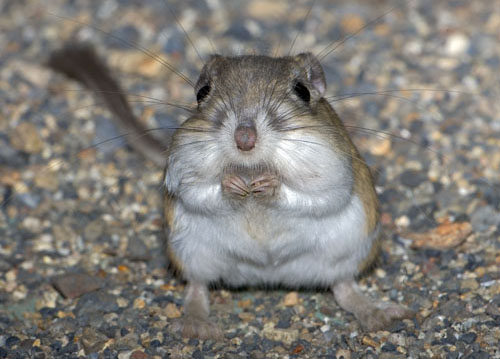
Unlike mice who leave urinary marks to display
dominance, kangaroo rats are interesting in that they use scents deposited at sand-bathing
sites for social communication to establish dominance hierarchical relationships (Shier & Randall, 2007). It is interesting to note that dominant kangaroo rats sand-bathed at
higher rates than subordinates. This is thought to be a strategy for the rats to
advertise competitive ability, whereas subordinate kangaroo rats foot-drummed
from inside the burrows that seem to indicate an unwillingness to interact. This
recognition and communication of dominance status can be important means of
minimizing costly interactions and resolving interactions without severe
aggression. (Shier & Randall, 2007)
Cats

Cats use a variety of marking behaviors to
communicate, including urine, feces, claws and scent glands. Unique to the cat, cats have a
special “scent analyzer” called a vemeronasal organ located above the roof of
the mouth that is used for analyzing pheromones. This organ is most utilized
for examining pheromones found in urine, but the cat will also utilize this
analyzer whenever it comes across an interesting scent. The scent is
collected in the mouth and the tongue transfers it up to the ducts located just
behind the front teeth. If you have a cat you will notice that when they are engaging
in this, their mouth will be partially open with the upper lip curled which is
known as the flehman response.


To dogs we
are our scent, this allows dogs to tell identical twins apart just by scent.
Their sense of smell is so strong that they can also figure out if you've had
sex, smoked a cigarette, and even the order in which that happened. As
discussed above, dogs also partake in urine marking as a primary method of
communication. Dogs utilize urine marking to give and investigate information
about, for females, sexual readiness and for males, their social confidence (Horowitz, 2010). Contrary to popular belief that dogs use urine markings for territorial
purposes, dogs that were left to their own devices marked, but only 20% of the markings
were territorial (Horowitz, 2010).

By Meryam Popal
Works Cited
Horowitz,
A. (2010). Inside of a dog, what dogs see, smell, and know. Scribner
Book Company.
Johnson-Bennett,
P. (2004). Cat vs. cat: keeping peace when you have more than one cat.
New York, NY: Penguin.
Nevison, C.M., Armstrong, S., Beynon, R.J., Humphries, R.E., & Hurst, J.L. (2003). The Ownership Signature in Mouse Scent Marks Is Involatile. Proceedings: Biological Sciences , Vol. 270.
Shier, D. M., & Randall, J.A. (2007). Use of different signaling modalities to communicate status by dominant
and subordinate Heermann's kangaroo rats (Dipodomys heermanni). Springer.
Retrieved from
http://www.jstor.org/stable/27823476

I was surprised to find that both mice and cats somehow use smell to identify social status/ worth within their own societies. This draws a direct parallel to human behavior in that we often judge others on their smell and attribute or detract worth based on our interpretation of that smell, especially in light of the universality of pleasant/unpleasant smells within our culture today ( in regards to the perfume industry). However, in animal society their is no question of capital in regards to their ability to obtain a pleasant smell, while economic capital is a necessary component in the acquisition of smell enhancing products for humans (i.e. perfumes, lotions, etc.).
ReplyDelete