Friday, April 20, 2012

Animals and Scent


     Samuel Jackson Holmes, an American zooligist and eugenist, states that the main feature that allows animals to discriminate the sex of their other species is the sense of smell. Each specie has a distinct odor that can be detected by other members of that specie (Holmes, 1916; 219). And this distinction can be detected in different ways. For example, vertebrates identify smell with their noses, whereas insects use their antennas to identify smell (Schaefer & Ruxton, 2011). In many groups of animals, the male olfactory organ is better developed than that of a female. For example the male insects antennas contain a larger olfactory organ than the females.

     In the book "Animals In Translation", Temple Grandin and Catharine Johnson talk about the research that has been done on vision, smell and the relationship between the two. This research is done on the new world animals, which are the more well known animals such as gorillas, baboons, and chimpanzee. Also done in relations to the old world animals are the smaller primates and monkeys (Grandin & Johnson, 2006; 61).

     It is important to keep in mind that certain odors stimulate only a certain group of receptors. These receptors on the other hand recognize odors that are chemically related to them (Schaefer & Ruxton, 2011). In some cases animals can read messages about their owner health by using their sense of smell. Furthermore, animals have an ability to smell fear. This can then be used as a way to communicate and alert other animals within their species (Bogdashina, 2010; 150).


Gorilla 
Baboon
Chimpanzee 
Monkeys  
    The old world primates and humans are known to have a weaker sense of smell, compared to other animals who rely heavily on this sense as a main source for communication. Pheromones are “chemical signals animals emit as a form of communication" (Grandin & Johnson, 2006; 61). For humans and old world primates, our other senses play a key role in order to communicate and navigate through the world. Research has shown that evolution has caused the pheromone system of the old world and humans to break down. This was a result of them not using their sense of smell as much, which gradually resulted in a weak sense of smell and an increase in reliance on eyesight.

   Our blog is aimed to show how pheromones operate as a way for animals to communicate with one another, as well as how their sense of smell operates. And due to the fact that not all animals use smell in the same way, we have broken our discussion down into three groups, insects, land animals, and marine animals, to illustrate how scent is a key component to how they communicate!


By Kelly Peters, Shaudee Farboudmanesh, Meryam Popal, and Cassie Kobrin

Works Cited


Bogdashina, O. (2010). Autism and the edges of the known world: Sensitivities, language, and constructed reality. Jessica Kingsley Publishers.

Johnson, C., & Grandin, T. (2006). Animals in translation: Using the mysteries of autism to decode animal behavior. Houghton Mifflin 

Holmes, S. (1916). Studies in animal behavior. R. G. Badger.

Schaefer, M., & Ruxton, G.  (2011). Plant-animal communication. Oxford University Press..


Pheromones


The Down Low on Pheromones       

     Pheromones are molecules used for communication and interaction between animals, specifically, animals within the same species. More specifically, University of California Riverside entomologist defines pheromones as, “a chemical or a mixture of chemicals that is released to the exterior by an organism of the same species. Thus, if two or more chemicals are released together and cause a specific reaction, the chemical mixture must be regarded as a pheromone” (Shorey, 1976). 


     The term pheromone is originally derived from the Greek word, pherein, to carry or transfer, and, hormon, to excite or stimulate (Whatt, 2003). Since most animals cannot communicate through language as humans do, pheromones are widely used within the animal world and serve as a means of transmitting information from one member of the species to another (Shorey, 1976).


     Although the need is less obvious than for groups of animals, the need for pheromones is extremely important for solitary animals. These animals appear to live alone for the majority of the time except for crucial moments in their lives when they may use pheromones to find animals of the same species to mate with or to keep them from coming together with one another at inappropriate times (Shorey, 1976).  The way pheromones are released and transmitted can be broken into two main categories: releaser pheromones and primer pheromones, both of which are equally important to any animal. 


     Releaser pheromones elicit immediate responses by being mediated by the nervous system. The response to releaser pheromones cannot be seen, but may affect the reactivity of an animal to things such as danger or sound. On the other hand, primer pheromones go through the central nervous system after detection and cause direct and visible responses. One example of primer pheromones is the changing of hormonal levels of male and female animals causing them to mate (Shorey, 1976).
      
    A tiger is an example of a solitary animal. These animals come 
together to mate but part ways soon after. 


     Within these categories, pheromones are divided by function as well. Each set of pheromones triggers a function which in tern leads to a type of behavior. The way it works is pheromones from one animal cause another to show signs of behavior reactions about the animal releasing the pheromone. The different types of pheromones that cause these behaviors has been broken into three categories: recognition pheromones, identification pheromones, and appraisal pheromones. (Note that the naming of these categories often varies, but the behaviors they elicit are the same) (Wyatt, 2003).


     Recognition pheromones cause the receiving animal to perceive a pheromone as something that is previously known. For example, these pheromones can recognize the animal’s own home or other animals of the same species. Next, identification pheromones are used to recognize individuals and of prior recognition of these animals such as a mate or parent. For example, the tiger above uses his recognition pheromones to find other tigers, but once he find them he then uses his identification pheromones to determine which is his mother. The mixes of chemicals that produce these identification pheromones are unique in order for one animal to identify a specific other, thus the tiger can figure out which tiger is his mother (Shorey, 1976). Each species has different types of pheromones specific to that species that differentiates them from other species (all tigers) while each individual member of that species has exclusive pheromones that makes him or her recognizable to others within their species (the tiger above). The final category of pheromones is appraisal pheromones. Appraisal pheromones are used for animals within the same species as a stimulus for a specific action. Appraisal pheromones can lead to animals mating, dispersion, aggression, etc. (Shorey, 1976). The tiger above uses his appraisal pheromones to find a mate. 


Click the link below to see how animals use pheromones to find a mate:
Pheromones in Mating: What Women Want
http://www.evtv1.com/player.aspx?itemnum=12868#


By Cassie Kobrin 
Works Cited


Shorey, H. (1976). Animal communication by pheromones. Academic Press.

Wyatt, T. (2003). Pheromones and animal behavior: communication by smell and taste. Cambridge University Press.


Video retrieved from: EVTV1.com
          

Insects


MOTHS

     Unlike the human device for smelling, that is centered around the nasal passages, insects experience smell in a very different way. Insects have olfactory pores, located all over their bodies, that help them to capture scent. The most commonly known scent detector is located in their antennas. But the way that insects communicate through scent can differ between groups of species.

     Moths, for example, have been know to use their attuned sense of smell as a way to mate. Linn,Campbell, and Roelofs (1988) discuss how blends of pheromones are created amongst moths in order to attract a mate and begin courtship. But often times this means that the female will release a blend of pheromones that a group of male moths will have to use in order to find the female moth's location. Male moths can encounter many difficulties in just finding the mate due to the fact that it can be hard to pinpoint a females pheromones when there could be similar pheromones blend being produced by another nearby species. So moths, especially males moths, encounter many obstacles in trying to find a mate. But being able to effectively recognize these specific blends of pheromones is a crucial component in order to compete against other males in finding courtship. The olfactory senses within insects are extremely important. When their olfactory senses are disrupted, by other natural or synthetic pheromones, this can negatively effect the outcome of being able to mate, and ultimately communicate.


      Just imagine how difficult that could be in having to keep hold of at least a minimal amount of the pheromone you are tracking down, otherwise your communication between your future mate is doomed!

      In an article, titled “Talking smells - how animals use their sense of smell to communicate”, it discusses how farmers are able to use pheromones themselves as a way to trick insects into following a pheromone that appears to be natural. So pheromones are used to lure insects, such as moths, into traps in order to remove them without having to use harmful poisons that could affect the environment. It is a way for humans to communicate with insects by appealing to the insect's strong ability to pick up on smells (Prescott, 1995: paragraph 9). 


BEES

     Bees have the capability of producing up to 36 different pheromones, which are used to communicate with other bees as they coordinate on which flowers to pollinate. This is said to be called their “chemical language” because they communicate through the use of smell, rather than just following one another by sight. But not only do bees communicate with one another, plants also communicate with bees in the way that they produce different floral odors. Flowers release chemicals that can be detected by bees, which in turn helps them decide which flowers are most desirable to pollinate.

     But bees do not just look to flowers for pollination. In a scholarly journal titled “Orchid Bees Don't Need Orchids: Evidence from the Naturalization of an Orchid Bee in Florida” (Pemberton &Wheeler, 2006: 1995), it discusses how scent can attract bees even if they do not contain pollen. These male orchid bees are “attracted to the volatile floral fragrances, which they collect from the surfaces of the flowers”. And although no pollination, nectar, or a reward of food is provided, the scent of these orchids are used by bees as “sexual perfumes during their courtship and possibly territorial defense” (Pemberton &Wheeler, 2006: 1995). This just goes to show that scent is used in a variety of ways, and can be used to communicate with female bees (appraisal pheromones).

     So bees communicate through scent while working with fellow bees in the process of pollination, but it can also be used to communicate with female bees, in certain areas, as a way to lure them into mating. 


ANTS

     Ants are not the first insect that came to mind when I was thinking about animal communication. But they are very fascinating in their ability to communicate through scent in order to find food and create chemical trails that their fellow ants can trace. In "Talking smells - how animals use their sense of smell to communicate", the article discusses how ants use the tips of their antennas to follow scents, that have been marked on the ground by ants that came before them. “The ant wipes its abdomen on the ground. This leaves a tiny chemical trail” (Prescott, 1995: Paragraph 10). This tactic is used in order to navigate and communicate with one another. And this chemical smell is often used to guide ants to where food can be found!


    I think that ants are not given the credit they deserve in how complex their communication signals are with one another. It has been said that insect semiochemicals are complex mixtures, and therefore we must look at the interaction between the insect that releases pheromones as well as that of the receiver. Due to this complex pheromone mixture that insects (including ants) release, it is said that this chemical communication system can effect the insect receiver differently depending on the pheromone mixture that is produced. In other words, “the behaviors of the signal sender, as well as that of the signal receiver, depend strongly on the motivational states of the individuals” (Doty, 2010: 192).


      Think of it this way: remember the conduit metaphor from COHI 100? Well the conduit metaphor implies that the sender transmits a message, and the person on the other end simply receives it. But the receiver does more than just receives because they have to process the information and respond in some way (because the message might have been communicated, but not necessarily understood). It is not just one-directional. So in terms of the way insects communicate with one another, we have to look beyond just the simplified version of what pheromones do. Pheromones are molecules that are released by a species, but it works both ways and can create different emotions or reactions when communicating through scent, rather than just seeing pheromones in a unidirectional way.

     Pheromones offer us the ability to see how animals communicate through the sense of smell, but we should also look to how insects-and other animals- are affected when other factors are considered- such as emotional responses or environmental factors- such as synthetic pheromones blurring natural scents.

     Insects use their olfactory senses in so many ways in order to communicate. We can see how scent is used to locate flowers for pollination (for bees), identify female species (for bees and moths), to recognize familiar scents in order to communicate the direction the insect is heading (for ants), and how pheromones play a crucial role in mating.

By Kelly Peters 
Works Cited 


Doty, Richard L. (2010). The Great Pheromone Myth. The Johns Hopkins University Press, 192.

Linn, C.E., M.G. Campbell, and W.L. Roelofs. (1988). Pheromone Components and Active Spaces:  
     What Do Moths Smell and Where Do They Smell It? American Association for the Advancement 
     of Science.

Prescott, Lyle. (1995). Talking Smells- How Animals Use Their Sense of Smell to Communicate. 
     Businnes Library: Find Articles.

Wheeler, Gregory S., and Robert W. Pemberton. (2006). Orchid Bees Don't Need Orchids: Evidence 
     from the Naturalization of an Orchid Bee in Florida. Ecological Society of America

Land Animals


Land animals use scent to communicate dominance, sexual attractiveness, to convey information about territorial holdings and much more. I will be discussing how mice, cats and dogs use their sense of smell to communicate as well as gain information about their surroundings.

Mice


Mice leave urinary markings that contain a pattern of major urinary proteins (MUPS) that allow them to distinguish another male’s scent from their own. Not only do these give information about the source of the urine, their urine also contains sex-specific volatile pheromones that are attractive to both female and male mice. It is interesting to note that these pheromones have been shown to stimulate aggression between males and have reproductive priming effects on females. Not only does their urine signal the species and sex of the scent owner and but it also plays a part in signaling social status. (Nevison, Armstrong, Beynon, Humphries & Hurst, 2003)

Kangaroo rats


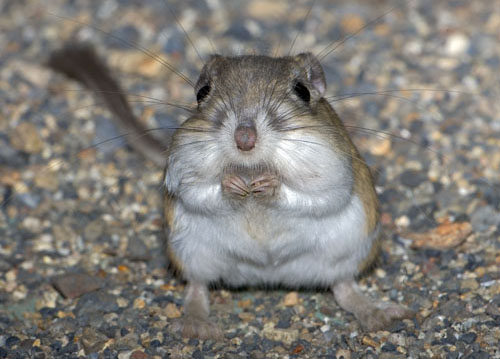
Unlike mice who leave urinary marks to display dominance, kangaroo rats are interesting in that they use scents deposited at sand-bathing sites for social communication to establish dominance hierarchical relationships (Shier & Randall, 2007). It is interesting to note that dominant kangaroo rats sand-bathed at higher rates than subordinates. This is thought to be a strategy for the rats to advertise competitive ability, whereas subordinate kangaroo rats foot-drummed from inside the burrows that seem to indicate an unwillingness to interact. This recognition and communication of dominance status can be important means of minimizing costly interactions and resolving interactions without severe aggression. (Shier & Randall, 2007)

Cats


            Cats use a variety of marking behaviors to communicate, including urine, feces, claws and scent glands. Unique to the cat, cats have a special “scent analyzer” called a vemeronasal organ located above the roof of the mouth that is used for analyzing pheromones. This organ is most utilized for examining pheromones found in urine, but the cat will also utilize this analyzer whenever it comes across an interesting scent. The scent is collected in the mouth and the tongue transfers it up to the ducts located just behind the front teeth. If you have a cat you will notice that when they are engaging in this, their mouth will be partially open with the upper lip curled which is known as the flehman response.


            Similar to the mice discussed earlier, cats also engage in urine marking. This is a very effective form of communication that cats use to convey multiple messages. Urine marking is used to mark territory, threaten, announce their arrival, engage in dispute without confronting each other, or exchange information. Cats also engage in rubbing, this action makes the cat release pheromones which contain information about the cat, and other cats use this information to figure out if the cat is male or female, sexually available, and to determine how long ago the scent was left. Rubbing also allows them to mark territory, in a household with multiple males, higher-ranking cats engage in more facial rubbing than the lower ranking ones similar to the dominant kangaroo rats that engaged in more sand-bathing compared to subordinates. In addition, I was surprised to find out that rubbing also allows cats to collect or combine scents as well as bond and show respect from a lower-ranking cat to a higher-ranking one. Bonding behavior is called bunting and may also be related to status depending on the circumstances. Usage of scent is also a survival instinct; cats living together rub one another to create a familiar colony scent to help them identify whether a cat entering the territory is familiar or an intruder. (Johnson-Bennett, 2004)

Dogs


            To dogs we are our scent, this allows dogs to tell identical twins apart just by scent. Their sense of smell is so strong that they can also figure out if you've had sex, smoked a cigarette, and even the order in which that happened. As discussed above, dogs also partake in urine marking as a primary method of communication. Dogs utilize urine marking to give and investigate information about, for females, sexual readiness and for males, their social confidence  (Horowitz, 2010). Contrary to popular belief that dogs use urine markings for territorial purposes, dogs that were left to their own devices marked, but only 20% of the markings were territorial (Horowitz, 2010). 


By Meryam Popal 


Works Cited

Horowitz, A. (2010). Inside of a dog, what dogs see, smell, and know. Scribner Book Company.

Johnson-Bennett, P. (2004). Cat vs. cat: keeping peace when you have more than one cat. New York, NY: Penguin.


Nevison, C.M., Armstrong, S., Beynon, R.J., Humphries, R.E., & Hurst, J.L. (2003). The Ownership Signature in Mouse Scent Marks Is Involatile. Proceedings: Biological Sciences , Vol. 270.


Shier, D. M., & Randall, J.A. (2007). Use of different signaling modalities to communicate status by dominant and subordinate Heermann's kangaroo rats (Dipodomys heermanni). Springer. Retrieved from
http://www.jstor.org/stable/27823476


Marine Animals


        Animals communicate using all their senses, one of the most common tools for animal communication is their sense of smell. They Communicate with one another through the odors revealed by other species. They release certain odors in different situations. Marine animals for example communicate differently than land animals. They have some abilities that separates them from the others.

        According to David Ross, at times when the there is little to no light under water fish depend on their sense of smell to get by. Anglers call such fish "nose sensitive", they use their sense of smell to get to the source, their sense of vision to locate them, and finally their sense of taste to determine whether or not the food is edible (Ross, 2000; 142). The degree of response to food smells varies from times that the fish has just eaten versus times when it is hungry. They usually have a stronger reaction when they are hungry versus times that they have just been fed. Fish find food with the help of their other species and the traces that they leave behind. when one feeds it urinates or excrement leading other fish to the source of the food. Similarly some fish alert one another from danger through the odor they produce. There are also instances where their damaged skin emits an odor that alerts others of dangers that may be nearby. Many fish communicate with one another through chemical odors. They "emit pheromones (a type of chemical compound) that can attract members of the opposite sex for mating or influence other types of fish behavior" (Ross, 2000; 143). 

        The placements of nostrils has a major affect on the marine animals ability to smell. According to Phillip and Elaine Heemstra, most fish have paired nostrils, a posterior and a anterior nostril that is located on each side of their nose. The fish olfactory organs, are the "smell 'sensor' within the nares, which contains numerous odor-sensing cells. For fish to smell, water must move most rapidly over these cells" (Ross, 2000; 141). They are usually rounded plates of sensory tissues located in the nasal area. On the other hand there are also species that only have one nostril. These fish do not rely on their sense of smell as much as the others, but instead they rely on their sense of vision. Some of these fish are Cutlassfish, damselfish, and wrasses (Heemstra & Heemstra, 2004; 30).  


Cutlass fish
Wrasses Fish 
Damsel fish 

          A very interesting group of marine animals are sharks who are known for their strong sense of smell and their strong olfactory organs that allows them to smell different odors from kilometers away. They need stronger sense of smell in order to survive since they do not have a strong sense of vision. According to Mark Carwardine, out of all the Marine animals, sharks probably have diverse ways in sensing their surroundings  compared to other predators. They have additional senses that are unfamiliar to humans that allows them to survive under water. These marine animals have nostrils that are not connected to the repertory system which gives them the ability to smell under water. In addition they are able to sense molecules in the water and in the air. "For a shark smelling is effectively a form of long distance tasting, the main difference being that  the water is 'tasted' by special receptor cells in the nostrils rather that by taste buds inside the mouth" (Carwardine, 2004; 48). 

       In the "Shark", Carwardine mentions that sharks pick the scents that they choose to smell, they are mostly attracted to scents that are relevant to feeding and breeding purposes. They are able to follow odors in moving water from hundreds of meters away. They also use their nose to detect the direction of a particular odor the same way humans use their ears. By turning their nostrils they smell their surroundings, just like humans move their head around towards a sound in order to hear better. Sharks tend to swim in a zigzag path to locate the more concentrated area of the water (Carwardine, 2004; 48). The distance between their nostrils are also important for sharks. A smell that is coming from the right direction reaches the right nostril a fraction of second earlier than the left nostril. As a result the hammerhead sharks, that have a greater distance between their nostrils, are able to locate where the smell is coming from more sufficiently. 


Hammerhead Shark

        For a Whale shark, after it locates food it opens its mouth widely and inhales the water that contains the targeted prey. The food is then "caught on the special combs on the whales shark's gills" (Randolph, 2007; 15). 

Whale Shark 

        Another group of marine animals are dolphins that are not as dangerous as sharks. Julia Barnes talks about them in "The Secret Lives of Dolphins". These species, unlike sharks have very poor sense of smell. As a result they do not use this sense to locate food or a mean of communication (Barnes, 2007; 11). As an alternative they use their sense of taste to access chemicals in the water.


By Shaudee Farboudmanesh 
Works Cited
     Barthes Julia, J. (2007). The secret lives of dolphins. Gareth Stevens.
     Carwardine, M. (2004). Shark. Firefly Books.
     Communication in animals. (2011). Retrieved from
         http://www.ypte.org.uk/environmental/communication-in-animals/19
      Heemstra, P., & Heemstra, E. (2004). Coastal fishes of southern africa. NISC
      Randoph, J. (2007). The whale shark: gentle giant. The Rosen Publishing Group,.
      Ross, D. (2000). The fisherman's ocean. Stackpole.