
MOTHS
Unlike the human device for smelling, that is centered
around the nasal passages, insects experience smell in a very different way.
Insects have olfactory pores, located all over their bodies, that help them to
capture scent. The most commonly known scent detector is located in their
antennas. But the way that insects communicate through scent can differ between
groups of species.
Moths, for example, have been know to use their attuned sense of smell as a way to mate. Linn,Campbell, and Roelofs (1988) discuss how blends of pheromones are created amongst moths in order to attract a mate and begin courtship. But often times this means that the female will release a blend of pheromones that a group of male moths will have to use in order to find the female moth's location. Male moths can encounter many difficulties in just finding the mate due to the fact that it can be hard to pinpoint a females pheromones when there could be similar pheromones blend being produced by another nearby species. So moths, especially males moths, encounter many obstacles in trying to find a mate. But being able to effectively recognize these specific blends of pheromones is a crucial component in order to compete against other males in finding courtship. The olfactory senses within insects are extremely important. When their olfactory senses are disrupted, by other natural or synthetic pheromones, this can negatively effect the outcome of being able to mate, and ultimately communicate.
Just imagine how difficult that could be in having to keep hold of at least a minimal amount of the pheromone you are tracking down, otherwise your communication between your future mate is doomed!
In an article, titled “Talking
smells - how animals use their sense of smell to communicate”, it discusses how
farmers are able to use pheromones themselves as a way to trick insects into
following a pheromone that appears to be natural. So pheromones are used to
lure insects, such as moths, into traps in order to remove them without having
to use harmful poisons that could affect the environment. It is a way for
humans to communicate with insects by appealing to the insect's strong ability
to pick up on smells (Prescott, 1995: paragraph 9).

BEES
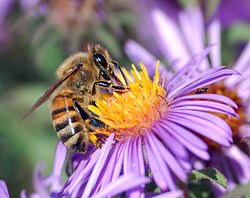
Bees have the capability of producing up to 36 different
pheromones, which are used to communicate with other bees as they coordinate on
which flowers to pollinate. This is said to be called their “chemical language” because they communicate through the use of smell, rather than just following
one another by sight. But not only do bees communicate with one another, plants
also communicate with bees in the way that they produce different floral odors.
Flowers release chemicals that can be detected by bees, which in turn helps
them decide which flowers are most desirable to pollinate.
But bees do not just look to flowers for pollination. In a
scholarly journal titled “Orchid Bees Don't Need Orchids: Evidence from the
Naturalization of an Orchid Bee in Florida” (Pemberton &Wheeler, 2006: 1995), it discusses how scent can attract
bees even if they do not contain pollen. These male orchid bees are “attracted
to the volatile floral fragrances, which they collect from the surfaces of the
flowers”. And although no pollination, nectar, or a reward of food is provided,
the scent of these orchids are used by bees as “sexual perfumes during their
courtship and possibly territorial defense” (Pemberton &Wheeler, 2006: 1995). This
just goes to show that scent is used in a variety of ways, and can be used to
communicate with female bees (appraisal pheromones).
So bees communicate through
scent while working with fellow bees in the process of pollination, but it can
also be used to communicate with female bees, in certain areas, as a way to
lure them into mating.

ANTS
Ants are not the first insect that came to mind when I was
thinking about animal communication. But they are very fascinating in their
ability to communicate through scent in order to find food and create chemical
trails that their fellow ants can trace. In "Talking
smells - how animals use their sense of smell to communicate", the article discusses how ants use the tips
of their antennas to follow scents, that have been marked on the ground by ants
that came before them. “The ant wipes its abdomen on the ground. This leaves a
tiny chemical trail” (Prescott, 1995: Paragraph 10). This tactic is used in order to navigate and communicate
with one another. And this chemical smell is often used to guide ants to where
food can be found!

I think that ants are not given the credit they deserve in how complex their communication signals are with one another. It has been said that insect semiochemicals are complex mixtures, and therefore we must look at the interaction between the insect that releases pheromones as well as that of the receiver. Due to this complex pheromone mixture that insects (including ants) release, it is said that this chemical communication system can effect the insect receiver differently depending on the pheromone mixture that is produced. In other words, “the behaviors of the signal sender, as well as that of the signal receiver, depend strongly on the motivational states of the individuals” (Doty, 2010: 192).
Think of it this way: remember the conduit metaphor from
COHI 100? Well the conduit metaphor implies that the sender transmits a
message, and the person on the other end simply receives it. But the receiver
does more than just receives because they have to process the information and
respond in some way (because the message might have been communicated, but not
necessarily understood). It is not just one-directional. So in terms of the way
insects communicate with one another, we have to look beyond just the
simplified version of what pheromones do. Pheromones are molecules that are
released by a species, but it works both ways and can create different emotions
or reactions when communicating through scent, rather than just seeing
pheromones in a unidirectional way.
Pheromones offer us the ability to see how animals
communicate through the sense of smell, but we should also look to how
insects-and other animals- are affected when other factors are considered- such
as emotional responses or environmental factors- such as synthetic pheromones
blurring natural scents.
Insects use their olfactory senses in so many ways in order
to communicate. We can see how scent is used to locate flowers for pollination
(for bees), identify female species (for bees and moths), to recognize familiar
scents in order to communicate the direction the insect is heading (for ants),
and how pheromones play a crucial role in mating.
By Kelly Peters
Works Cited
Doty, Richard L. (2010). The Great Pheromone Myth. The Johns Hopkins University Press, 192.
Linn, C.E., M.G. Campbell, and W.L. Roelofs. (1988). Pheromone Components and Active Spaces:
What Do Moths Smell and Where Do They Smell It? American Association for the Advancement
of Science.
Prescott, Lyle. (1995). Talking Smells- How Animals Use Their Sense of Smell to Communicate.
Businnes Library: Find Articles.
Wheeler, Gregory S., and Robert W. Pemberton. (2006). Orchid Bees Don't Need Orchids: Evidence
from the Naturalization of an Orchid Bee in Florida. Ecological Society of America

Your post on the communication of insects really helped to illuminate how meaning making is universally not a black and white process marked by simply unpacking a message for humans or animals. I also found it interesting how ants wipe their tails on the earth to leave behind a smell. This notion that smell can permanently occupy a space is also reiterated through cats and their use of rubbing to apply smell and release pheromones. I wonder if it is through the rubbing that the smell is somehow activated.
ReplyDeleteI found your post on the scent-making practices of insects and its rebuttal of the conduit metaphor to be eye-opening. I would have never imagined that communication could be such a multidimensional and social process for animals as they are for human beings. However, the difference, it seems, is that for insects, scent practices are more felt, intentional, collective and conscious, a part of their cognitive behavior. For example, you talked about how ants purposely wipe their smell on the ground. It is part of their own animal culture. As for humans, some of our scent practices are conscious, like applying perfume. However other uses, such as recalling a memory or describing a place, smell is less intentional in our thought process. Rather it is just there. I think your post highlights how we as human beings should pay more attention on how we can intentionally use smell for different purposes and smell as a cultural practice, such as how we rank the appeal of another person or how we determine which products are acceptable. And in relation to the conduit metaphor, this cultural practice is built upon our interactions with others as well. For example, the perception of perfume isn't just one-directional but dependent upon standards of smells for gender as well as the interaction between two individuals. How we decide to smell depends on society, as evoked by Alain Corbin.
ReplyDelete